

Truck shopping in 2026 comes down to one question: which pickups still deliver real value after somebody else has already paid the depreciation? At Serra Ford Rochester Hills, we help Michigan drivers cut through mileage anxiety, engine debates, and warranty fine print to land on a truck that will still be earning its keep five years from now.
The Ford F-150 is the best used truck to buy in 2026 for the majority of shoppers, and the value sweet spot is a 2018 through 2023 XLT or Lariat equipped with either the 5.0L V8 or the 2.7L EcoBoost V6. Those trucks typically list between $24,000 and $40,000 depending on mileage, cab, and trim, and they combine the corrosion-resistant aluminum-alloy body Ford adopted in 2015 with a 10-speed automatic and the largest parts-and-service network of any pickup on the road. Compare current Ford F-150 specifications against the trucks you are considering, then browse our used Ford F-150 inventory in Rochester Hills to see what your budget actually buys today.
Key Highlight
The strongest used truck values in 2026 sit in the three-to-six-year-old window. A 2020 to 2023 pickup has already absorbed its steepest depreciation, still carries modern driver-assist technology, and is often recent enough to qualify for factory-backed certified coverage.
This guide ranks the used pickups worth your money right now, explains what to inspect on any truck that has spent winters on salted Michigan roads, breaks down which used F-150 engine matches your workload, and lays out the financing and certification paths available when buying a used truck from our Rochester Hills dealership. Whether you tow a trailer every weekend or just need a bed for occasional hauling, the goal is the same: pay for capability you will actually use.
Key Takeaways
- The Ford F-150 is the best used truck to buy for most drivers in 2026, with 2018 to 2023 models offering the best mix of price, capability, and parts availability
- Condition and service records matter more than the odometer — a documented 120,000-mile truck often beats a neglected 70,000-mile one
- Rust inspection is non-negotiable on any Michigan truck; check frame rails, brake and fuel lines, cab corners, and bed supports
- Match the engine to the job: the 2.7L EcoBoost for daily driving, the 5.0L V8 for simplicity, the 3.5L EcoBoost for serious towing
- Ford Certified Pre-Owned coverage adds a multi-point inspection and factory-backed warranty protection that private-party trucks cannot match
What Makes a Used Truck Worth Buying in 2026
A good used truck is not simply a cheap one. The pickups that hold up are the ones with long production runs, widely stocked parts, straightforward mechanicals, and a dealer network that can service them without a two-week wait for a component. That is why our used truck specialists steer shoppers toward high-volume nameplates rather than niche configurations that look like a bargain until something breaks.
Pricing has also shifted in the buyer's favor. Used pickup values eased slightly through 2026 even as new full-size trucks pushed well past $60,000 on average, which widened the gap between a new truck payment and a lightly used one. A three-year-old half-ton with 40,000 miles now often costs $20,000 less than its new equivalent while retaining most of its useful life. If fuel cost is part of your math, our Ford F-150 fuel economy guide shows how much the engine choice changes your annual spend.
Parts and Service Availability
High-volume trucks like the F-150 mean common wear items are stocked locally and independent shops already know the platform — lower repair costs and shorter downtime
Documented Maintenance
Oil change intervals, transmission service, and differential fluid records tell you more about a truck's future than its mileage ever will
Resale Strength
Full-size pickups depreciate more slowly than most vehicle classes, so a well-chosen used truck protects your money when it comes time to trade
Age matters differently for trucks than for cars. A pickup used for light hauling and commuting can pass 200,000 miles with routine care, while a truck that spent its life at maximum tow weight may be tired at 100,000. Ask how the previous owner used it, look for a trailer hitch with wear marks, and check whether the transmission fluid has ever been serviced. Those three answers separate the trucks worth pursuing from the ones worth walking away from.

Late-model used F-150 cabins pair durable materials with modern SYNC technology — a major reason they lead the used truck market
Comparing the Best Used Trucks to Buy This Year
Four full-size pickups dominate the conversation when shoppers ask what's the best used truck to buy. Each has genuine strengths, and the right answer depends on how you weigh towing, ride comfort, running costs, and long-term parts support. Here is how they stack up in the 2026 used market.
| Used Truck | Best Model Years | Typical Price Range | Why It Stands Out |
|---|---|---|---|
| Ford F-150 | 2018–2023 | $24,000–$40,000 | Widest engine and cab selection, aluminum body, strongest parts network |
| Toyota Tundra | 2018–2021 | $28,000–$44,000 | Bulletproof 5.7L V8 reputation, fewer configurations and lower fuel economy |
| Chevrolet Silverado 1500 | 2019–2023 | $24,000–$41,000 | Strong V8 lineup and easy-to-service mechanicals, plainer interiors on lower trims |
| Ram 1500 | 2019–2023 | $23,000–$40,000 | Best-riding half-ton thanks to coil-spring rear suspension and upscale cabins |
Why the Ford F-150 Leads the Used Truck Market
Volume is the F-150's quiet advantage. Ford has sold more F-Series trucks than any competitor for decades, which means a deeper used supply, more configurations to choose from, and mechanics everywhere who know the platform cold. It also means you can be selective: instead of settling for the one Silverado in your price range, you can hold out for the exact cab, bed, drivetrain, and trim you want. For a closer look at the trade-offs, read our head-to-head breakdowns of the F-150 versus Ram 1500 and the F-150 versus Chevy Silverado 1500.
When a Mid-Size Used Truck Makes More Sense
Not every buyer needs a half-ton. If your hauling is limited to mulch, dirt bikes, or a small utility trailer, a mid-size pickup costs less to buy, insure, and fuel, and it fits in a standard garage. A used Ford Ranger with the 2.3L EcoBoost still tows up to roughly 7,500 pounds when properly equipped — plenty for most recreational loads — and typically saves several thousand dollars versus a comparable F-150. Choose the smaller truck when the bigger one's capability would sit unused.
What to Inspect Before Buying a Used Truck in Michigan
Southeast Michigan is hard on trucks. Road salt from November through March attacks anything steel underneath, and a pickup that looks flawless from ten feet away can hide expensive corrosion. Every used truck we retail goes through a reconditioning inspection, but if you are shopping privately or across state lines, these are the checks that protect you.
Rust and Undercarriage Condition
Start underneath with a flashlight. Surface scale on a frame rail is normal on a Michigan truck; flaking, layered rust you can chip away with a screwdriver is not. Pay particular attention to brake and fuel lines, the rear spring perches, cab corners, rocker panels, and the bed support crossmembers. On 2015 and newer F-150s the aluminum-alloy body panels resist the bubbling that plagued older steel-bodied trucks, but the frame and suspension hardware are still steel and still need a look.
Drivetrain Records and Cab Configuration
Ask for transmission service history on any truck with the 10-speed automatic transmission introduced in 2017, and on turbocharged trucks confirm the oil was changed on schedule with the correct specification. Cab choice deserves equal thought before you commit: our SuperCrew versus SuperCab comparison explains why the four-door SuperCrew is the right call for families, while a SuperCab with a longer bed serves buyers who prioritize cargo length over rear legroom.
Setting a Realistic Budget
Older, higher-mileage pickups can absolutely make sense, and our selection of used trucks under $15,000 is where a lot of first-time buyers and work-truck shoppers start. Just budget separately for wear items. Tires for a half-ton run $900 to $1,400 installed, brakes $400 to $700 per axle, and a set of shocks $600 to $1,000. Trucks at the bottom of the market are frequently due for at least one of those, so factor them in rather than being surprised three months after purchase.
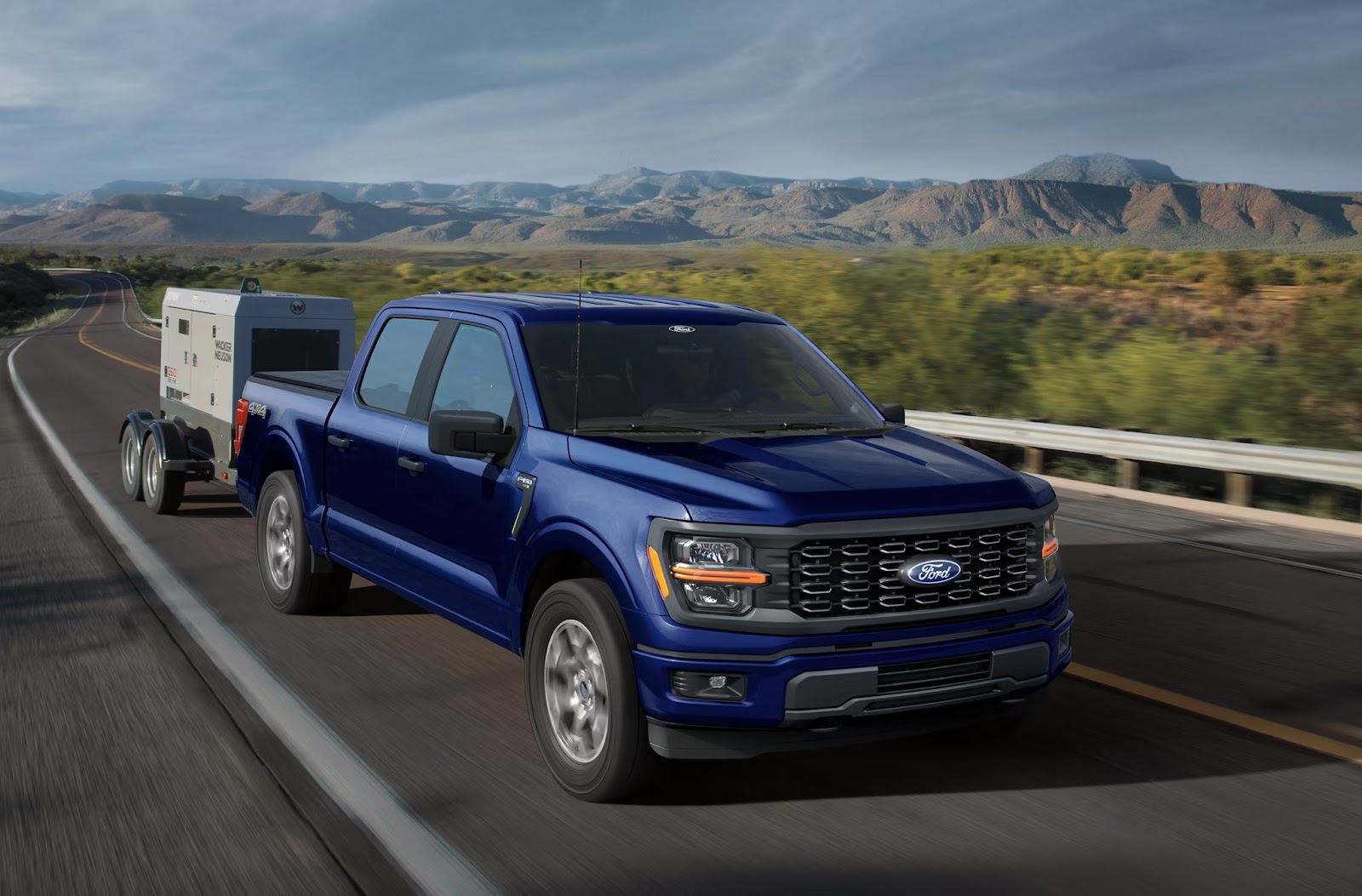
Aluminum-alloy body panels and a proven four-wheel-drive system make the used F-150 a strong fit for Michigan winters
Choosing the Right Used F-150 Engine and Towing Capability
Once you have settled on an F-150, the engine decision drives everything else — fuel cost, tow rating, maintenance complexity, and resale. Four powertrains make up the bulk of the 2018 to 2023 used supply, and each suits a different owner.
Used F-150 Engine Options Compared
The 5.0L V8 is the enthusiast and simplicity pick: naturally aspirated, no turbochargers or intercooler plumbing, and a sound most truck owners prefer. The 2.7L EcoBoost is the efficiency pick and delivers torque low enough that most drivers never miss the V8. The 3.5L EcoBoost is the towing pick, and the 3.3L V6 is the honest base engine for buyers who rarely load the bed.
| Engine | Model Years | Output | What Used Buyers Should Know |
|---|---|---|---|
| 5.0L V8 | 2018–2023 | 395–400 hp / 400–410 lb-ft | Simplest to maintain long-term; ideal all-around choice for most buyers |
| 2.7L EcoBoost V6 | 2018–2023 | 325 hp / 400 lb-ft | Best fuel economy of the gas engines; verify turbo-appropriate oil changes |
| 3.5L EcoBoost V6 | 2018–2023 | 375–400 hp / 470–500 lb-ft | Highest tow ratings; on 2018–2020 trucks ask about cam phaser service history |
| 3.3L V6 | 2018–2023 | 290 hp / 265 lb-ft | Lowest purchase price; adequate for light hauling, not for regular towing |
Matching Towing Capacity to Real-World Loads
Properly equipped, a used F-150 tows anywhere from about 5,000 pounds with a base V6 up to roughly 13,200 pounds on 2018 to 2020 3.5L EcoBoost trucks and as much as 14,000 pounds on 2021 and newer configurations. Most owners need far less: a 20-foot bowrider on a trailer runs 4,500 to 5,500 pounds and a mid-size travel trailer 6,000 to 8,000, both comfortably within a 2.7L EcoBoost truck's capability. Our F-150 towing capacity breakdown explains how axle ratio, cab, and tow package change the number on the door jamb sticker, and the team at our Ford service center can confirm what any specific used truck is rated to pull before you buy.
Financing and Certified Options for Used Truck Buyers
How you buy a used truck affects your total cost as much as which truck you choose. Used-vehicle interest rates continue to run several points above new-car promotional financing, so the term you accept and the down payment you make can swing thousands of dollars over the life of the loan. The fastest way to know your real budget is to get pre-approved before you start test driving.
Comparing Where You Buy
Private-party trucks are usually cheapest on paper but come with no warranty, no reconditioning, and no recourse if something surfaces a week later. Franchise dealer used inventory costs more but has been inspected and reconditioned, and financing is arranged in one place. Certified pre-owned sits at the top: a factory inspection plus manufacturer-backed warranty coverage that transfers with the truck.
| Buying Path | What You Get | Best For | Key Trade-Off |
|---|---|---|---|
| Private Party | As-is sale, no inspection or warranty | Mechanically confident buyers | Lowest price, all risk on you |
| Dealer Pre-Owned | Reconditioned, inspected, financing on site | Most used truck shoppers | Balanced price and protection |
| Ford Certified (Blue Advantage) | Multi-point inspection plus factory-backed limited warranty coverage | Buyers wanting new-truck peace of mind | Highest price, lowest risk |
Using Your Trade to Lower the Payment
Equity in your current vehicle is the cheapest down payment available. A transparent trade-in appraisal tells you exactly what that equity is worth against the truck you want, and you can start the process from home with a Kelley Blue Book instant cash offer. As an example, applying $6,000 of trade equity to a $32,000 used F-150 drops the financed amount to $26,000, which trims roughly $120 off a 60-month payment and saves meaningful interest overall. Call us at 248-468-6002 to talk through your numbers before you commit to a truck.
Shop the Best Used Trucks at Serra Ford Rochester Hills
Reading about used trucks only gets you so far. The difference between a 2.7L EcoBoost and a 5.0L V8, or between a SuperCab and a SuperCrew, becomes obvious in about ten minutes behind the wheel. Our team keeps a rotating selection of inspected used pickups on the lot and will put you in two or three back-to-back so you can feel the difference rather than guess at it.
Visit us at 2890 S Rochester Rd, Rochester Hills, MI 48307, and bring your questions — including the awkward ones about accident history, prior use, and what was replaced during reconditioning. We will pull the vehicle history report, walk you under the truck, and show you the inspection documentation. If the truck on our lot is not the right one, we will tell you that too and watch for the configuration you actually want.
Ownership support continues after the sale. Our service specials keep routine maintenance affordable, and our technicians can set up a maintenance schedule tailored to how you use the truck. Shopping the tighter end of the market? Ask about our trucks under $10,000. Call 248-468-6002 today to schedule a test drive and find out why the used Ford F-150 remains the best used truck to buy for drivers across Rochester Hills, Troy, Auburn Hills, and Sterling Heights.