

The Jeep Grand Wagoneer L and Cadillac Escalade ESV have the largest cargo space behind the 3rd row of any 2026 SUV, at roughly 42 to 43 cubic feet each, with the Chevrolet Suburban close behind at 41.5. The Ford Expedition MAX offers 36.1 cubic feet behind its third row, the most of any Ford, and our Ford dealership in Rochester Hills, MI helps families figure out how much of that space they will actually use before they buy.
If you want the biggest cargo hold in the Ford lineup, the 2026 Expedition MAX is the answer. Its extended body adds up to 11.8 inches of cargo length over the standard Expedition, which works out to 36.1 cubic feet behind the third row, 75.4 behind the second row, and 123.1 cubic feet with both rear rows folded, according to Ford's published Expedition specifications. It also tows up to 9,000 pounds in 4x4 form, so a packed cargo area and a camper or boat on the hitch are not an either-or decision. If you are pricing one now, our current Ford Expedition lease deals are the quickest way to see what a monthly payment looks like.
Key Highlight
Cargo space behind the 3rd row is the number that matters when every seat is filled. Extended-length SUVs such as the Expedition MAX and Suburban offer roughly two-thirds more room back there than their standard-length siblings, which is the difference between packing a cooler and packing a cooler, luggage, and a stroller.
This guide ranks the SUVs with the most room behind the third row, explains how automakers measure cargo volume, breaks down the Expedition MAX against the standard Expedition row by row, and shows where the midsize Ford Explorer fits for families who need three rows but not a full-size footprint. Every figure reflects 2026 specifications, so you can compare like for like before you visit.
Key Takeaways
- The Jeep Grand Wagoneer L, Cadillac Escalade ESV, and Chevrolet Suburban lead all 2026 SUVs in cargo space behind the 3rd row, each offering more than 41 cubic feet
- The 2026 Ford Expedition MAX provides 36.1 cubic feet behind the third row, or 37.4 with the seatbacks fully upright, the most of any Ford SUV
- Choosing the MAX over the standard Expedition adds about 14.5 cubic feet behind the third row and 11.8 inches of cargo length
- The 2026 Ford Explorer offers 16.3 cubic feet behind the third row and up to 85.8 cubic feet with both rear rows folded, a smart fit for families who only occasionally fill the third row
- If you regularly travel with every seat filled, compare the behind-3rd-row figure rather than maximum cargo volume
How Cargo Space Behind the 3rd Row Is Measured
Every automaker publishes three cargo numbers, and each one answers a different question. Volume is measured in cubic feet using industry-standard SAE methods, but small differences in seat position can move the result by a cubic foot or more. That is why Ford lists both a standard figure and an optimized figure for the Expedition, with the optimized third-row number measured with the seatbacks fully upright.
Shoppers often compare maximum cargo volume because it is the biggest number on the spec sheet, but that figure assumes both rear rows are folded flat, which turns a three-row SUV into a two-seater. If you are buying a three-row SUV to carry six, seven, or eight people, the space behind the third row is the measurement that predicts whether the luggage, sports gear, or groceries will fit on a real family trip.
Behind the 3rd Row
Usable space with every seat occupied, the number that matters most for large families, carpools, and airport runs with a full crew
Behind the 2nd Row
Room with the third row folded flat, ideal for a family of four or five hauling bikes, camping gear, or a warehouse-club shopping trip
Behind the 1st Row
Maximum volume with both rear rows folded, handy for moving furniture or flat-pack purchases but rarely how families actually travel
Shape matters as much as volume. A deep, square cargo well swallows upright suitcases and hockey bags far better than a shallow, sloped one with the same cubic-foot rating, and a low liftover height makes heavy items easier to load. When you test-drive, bring the stroller, cooler, or equipment bag you actually use and load it with the third row up. Five minutes in the parking lot tells you more than any spec sheet.
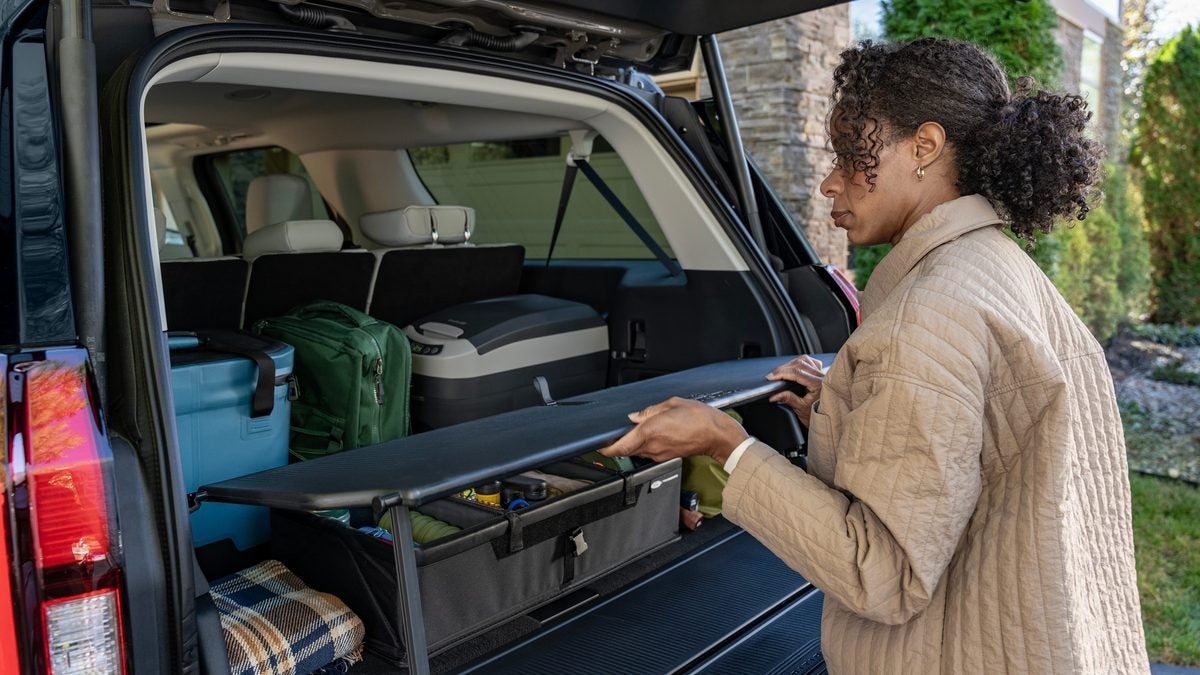
Coolers, a duffel and the available Cargo Tailgate Manager fit behind the Expedition's upright third row, and the longer MAX adds another 14.5 cubic feet
SUVs With the Largest Cargo Space Behind the 3rd Row in 2026
Only extended-wheelbase full-size SUVs clear the 35-cubic-foot mark behind the third row in 2026. Standard-length models such as the Chevrolet Tahoe and the regular Ford Expedition land between roughly 21 and 28 cubic feet, and most midsize three-row crossovers fall between 15 and 23. Here is how the longest SUVs on the market compare. Competitor figures are published 2026 specifications, rounded where sources differ slightly.
| Extended-Length SUV | Behind 3rd Row | Maximum Cargo | Why It Stands Out |
|---|---|---|---|
| Jeep Grand Wagoneer L | About 42.6 cu ft | About 116.7 cu ft | Deepest third-row cargo well of the group, paired with luxury-level pricing |
| Cadillac Escalade ESV | About 42 cu ft | About 142 cu ft | Near-identical third-row room to the Jeep with a premium price to match |
| Chevrolet Suburban | 41.5 cu ft | 144.5 cu ft | One of the largest maximum volumes on sale, shared with its GMC Yukon XL twin |
| Ford Expedition MAX | 36.1 cu ft (37.4 optimized) | 123.1 cu ft | Ford's biggest cargo hold, up to 9,000-lb towing (4x4), Split Gate, and available BlueCruise |
Why Extended-Length SUVs Dominate the Cargo Rankings
The extra room comes almost entirely from length added behind the rear axle. The Expedition MAX measures 221.7 inches long versus 209.9 inches for the standard Expedition, and that 11.8-inch stretch goes straight into the cargo floor. The same recipe separates the Suburban from the Tahoe and the Grand Wagoneer L from the regular Grand Wagoneer. The trade-off is maneuverability, since a nearly 18.5-foot SUV needs a deeper garage and more patience in tight parking lots, so measure your garage before you commit.
Where the Ford Expedition MAX Fits in the Ranking
On raw volume behind the third row, the Expedition MAX trails the Grand Wagoneer L, Escalade ESV, and Suburban by roughly 5 to 7 cubic feet, about the size of one or two large checked suitcases. Where it pulls ahead is everything around that space. It tows up to 9,000 pounds in 4x4 form, its standard 3.5L EcoBoost V6 makes 400 horsepower and 480 lb-ft of torque, and Ford's Split Gate lets you load from a tailgate-style lower door instead of reaching over a tall bumper. It also starts below the Grand Wagoneer L and far below the Escalade ESV. Shoppers who want to stretch their budget further can browse our used Ford Expedition inventory in Rochester Hills, where earlier MAX models deliver similar long-wheelbase practicality.
Ford Expedition MAX Cargo Space Behind the 3rd Row Explained
The Expedition MAX exists for one reason: families who fill every seat and still need real cargo room. The redesigned Expedition that arrived for the 2025 model year carries into 2026 with the same long-wheelbase formula, and Ford engineered the rear of the vehicle around how people actually load it.
Expedition MAX vs Standard Expedition Behind the Third Row
The gap is significant. The standard 2026 Expedition offers 21.6 cubic feet behind the third row, while the Expedition MAX offers 36.1, an increase of 14.5 cubic feet, or roughly two-thirds more space, with every seat in use. In practice, the standard model handles a grocery run or a few carry-on bags with the third row occupied, while the MAX handles a week of duffel bags for a larger family. If your third row stays folded most of the time, the standard Expedition's 60.8 cubic feet behind the second row may be all you need.
Split Gate and Loading Features That Make the Space Usable
Volume only helps if you can reach it. Ford's Split Gate divides the rear opening so the upper three-quarters lifts like a traditional liftgate while the lower quarter folds down like a pickup tailgate. That lower section supports up to 500 pounds, and the available Cargo Tailgate Manager adds a seatback so it doubles as a bench at youth sports games or a serving table at a tailgate. With available Open On Approach, the gate opens automatically as you walk up with the key fob. Active models use a 60/40 PowerFold third row with power recline, while Platinum and King Ranch versions step up to a 40/20/40 split, so you can drop one section for a long item and keep two seats available.
What Fits Behind the Expedition MAX Third Row
In practical terms, 36.1 cubic feet is enough for a full-size stroller plus several rolling suitcases, a stack of youth hockey bags for an early-morning tournament, or a week of camping gear for a trip Up North, all without folding a single seat. Families who regularly travel with grandparents, carpools, or a team's worth of equipment tend to outgrow the standard Expedition's third-row cargo area quickly, and that is exactly where the MAX earns its extra length.
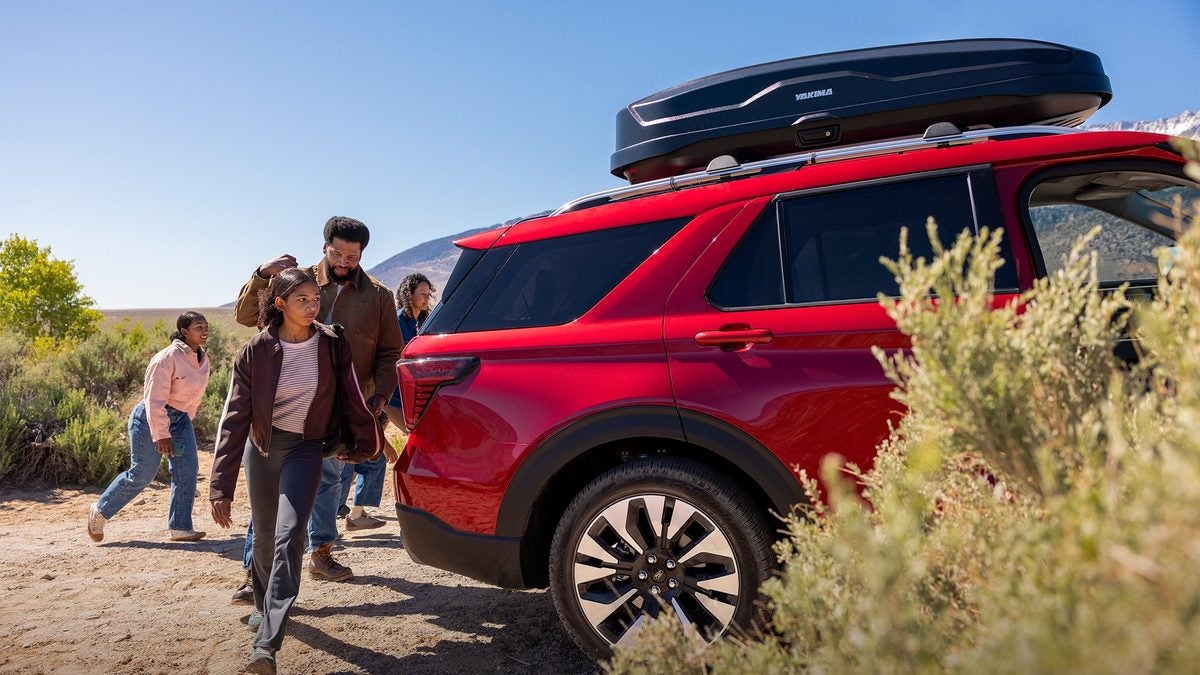
The 2026 Ford Explorer offers 16.3 cubic feet behind the third row and up to 85.8 cubic feet with both rear rows folded
Ford Expedition vs Expedition MAX Cargo Dimensions by Row
Ford publishes two sets of cargo numbers for the Expedition family: standard figures measured with the seats in their normal position, and optimized figures measured with the third-row seatbacks fully upright or the second row slid all the way forward. Both are useful, because the Expedition's adjustable seating lets you trade a little legroom for a little more cargo room when the trip calls for it.
Expedition and Expedition MAX Cargo Volume Compared
The table below lists the published cargo figures for the 2026 Expedition and Expedition MAX. The MAX adds roughly 14.5 cubic feet at every seating position, proof that the extra length goes into the cargo floor rather than the cabin. With the second row slid fully forward, Ford's optimized figures climb to 69.9 cubic feet for the Expedition and 84.5 for the MAX.
| Cargo Measurement | Expedition | Expedition MAX | MAX Advantage |
|---|---|---|---|
| Behind 3rd row (standard) | 21.6 cu ft | 36.1 cu ft | +14.5 cu ft |
| Behind 3rd row (seatbacks fully upright) | 22.9 cu ft | 37.4 cu ft | +14.5 cu ft |
| Behind 2nd row (standard) | 60.8 cu ft | 75.4 cu ft | +14.6 cu ft |
| Behind 1st row (maximum) | 108.5 cu ft | 123.1 cu ft | +14.6 cu ft |
Towing and Hauling at the Same Time
Cargo and towing work together on a full-size SUV. The standard Expedition 4x4 is rated to tow up to 9,600 pounds and the Expedition MAX 4x4 up to 9,000 pounds, so either one can pull a mid-size travel trailer or a pontoon boat while the cargo area carries the coolers and gear. Passengers, cargo, and trailer tongue weight all count against payload, so check the payload sticker on the door jamb before a fully loaded trip. The available 440-horsepower High-Output 3.5L EcoBoost V6 on Platinum models adds extra passing confidence when the vehicle is loaded to the roof.
Explorer vs Expedition vs Expedition MAX: Choosing the Right Ford 3-Row SUV
Not every family needs 36 cubic feet behind the third row. The right Ford comes down to how often the third row is occupied, what you tow, and whether the vehicle has to fit in an older garage. Many Rochester Hills families who use the third row only on weekends find that the midsize Explorer delivers everything they need with easier parking and a lower price.
Ford Explorer Cargo Space for Midsize Three-Row Families
The 2026 Ford Explorer offers 16.3 cubic feet behind the third row with all seats in place and up to 85.8 cubic feet with both rear rows folded on Active and ST-Line models, or 85.3 on ST, Platinum, and Tremor models, according to Ford's Explorer specifications. That is plenty for daily carpools and a weekend's worth of bags, and every Explorer includes a standard Class III Tow Package rated up to 5,000 pounds. Our 2026 Ford Explorer interior guide walks through seating layouts and storage, and our Ford Explorer vs Infiniti QX60 comparison shows how it stacks up against a popular three-row rival.
| Ford 3-Row SUV | Behind 3rd Row | Max Towing | Best For |
|---|---|---|---|
| Ford Explorer | 16.3 cu ft | 5,000 lbs | Families of five or six who use the third row occasionally and want easier parking |
| Ford Expedition | 21.6 cu ft | 9,600 lbs (4x4) | Heavy towing with a full cabin and moderate luggage |
| Ford Expedition MAX | 36.1 cu ft | 9,000 lbs (4x4) | Large families who fill every seat and still need room for luggage |
Trading Up to More Cargo Space
If you are shopping from nearby Oakland County communities, our Ford Explorer for sale near Auburn Hills page highlights current Explorer options for drivers a few minutes west along M-59. Already own an SUV that has become too small? Start with a KBB Instant Cash Offer on your trade-in to see how much equity you can put toward an Expedition MAX or Explorer, then call us at 248-468-6002 to talk through the numbers.
Find Your Three-Row Ford at Serra Ford Rochester Hills
Spec sheets only tell part of the story. The best way to judge cargo space behind the 3rd row is to load your own gear into an Expedition MAX, a standard Expedition, and an Explorer back to back. Our team will fold the seats, open the Split Gate, and show you exactly how a stroller, cooler, or set of hockey bags fits with every seat up.
Visit us at 2890 S Rochester Rd, Rochester Hills, MI 48307. Our sales team is available Monday through Thursday from 9:00 AM to 7:00 PM, Friday until 6:00 PM, and Saturday until 3:00 PM, and we are happy to line up several three-row Fords so you can compare them side by side in one visit.
Whether you are upsizing from a crossover, replacing an older Expedition, or weighing the Explorer against a full-size SUV, we serve drivers across Rochester Hills, Troy, Auburn Hills, Sterling Heights, and Shelby Township. Call 248-468-6002 today to schedule a test drive and find the Ford SUV with the cargo space your family actually needs.