

At Serra Ford Rochester Hills in Rochester Hills, MI, we help drivers choose between the 2026 Ford F-150's 5.0L V8 and EcoBoost engines for towing every day. The 3.5L EcoBoost V6 delivers the highest conventional towing capacity at 13,500 pounds, while the 5.0L Ti-VCT V8 offers 12,800 pounds of max towing with traditional naturally aspirated power delivery.
Both engines pair with Ford's 10-speed automatic transmission and offer serious capability, but the right choice depends on your specific towing needs, driving preferences, and how close you run to maximum capacity. The EcoBoost produces 500 lb-ft of torque compared to the V8's 410 lb-ft, which translates to stronger low-end pulling power. However, the 5.0L V8 delivers 400 horsepower with predictable throttle response that many experienced towers prefer. Our sales team at Serra Ford Rochester Hills can walk you through real-world towing scenarios to help you make the right decision.
Key Highlight
The 2026 F-150's 3.5L EcoBoost V6 leads the lineup with a maximum towing capacity of 13,500 pounds when properly equipped, while the 5.0L V8 offers 12,800 pounds with a max payload of 2,235 pounds—both engines deliver serious capability for Rochester Hills drivers hauling boats, trailers, and equipment.
This guide compares engine specifications, real-world towing performance, payload considerations, and fuel efficiency to help you choose the best powertrain for your needs. We'll cover how each engine performs on Michigan highways, what "properly equipped" actually means, and why payload capacity often matters more than the towing number on the spec sheet.
Key Takeaways
- The 3.5L EcoBoost V6 offers the highest towing capacity at 13,500 pounds with 500 lb-ft of torque
- The 5.0L Ti-VCT V8 delivers 12,800 pounds max towing with 400 horsepower and traditional V8 throttle response
- Payload capacity can limit towing before you reach max tow ratings—the 3.5L EcoBoost offers up to 2,440 pounds payload while the 5.0L V8 provides 2,235 pounds
- The EcoBoost's twin-turbo design delivers stronger low-end torque for accelerating with heavy loads
- Serra Ford Rochester Hills in Rochester Hills helps drivers match engine choice to real-world towing needs, not just spec sheet maximums
- Both engines pair with Ford's 10-speed automatic transmission and available Max Trailer Tow Package for optimal performance
Engine Specifications and Towing Capacity Comparison
The 2026 Ford F-150 offers two primary engines for serious towing: the 3.5L EcoBoost V6 and the 5.0L Ti-VCT V8. The EcoBoost produces 382 horsepower and 500 lb-ft of torque through twin turbochargers, while the naturally aspirated V8 generates 400 horsepower and 410 lb-ft of torque. For 2026, the EcoBoost's horsepower dropped slightly from 400 to 382 due to a new emissions filter, but torque remains unchanged and real-world performance is nearly identical.
Maximum towing capacity tells only part of the story. The EcoBoost's 13,500-pound rating requires the right configuration—typically a Regular Cab or SuperCab with the Max Trailer Tow Package, 3.55 rear axle ratio, and 4x2 drivetrain. The 5.0L V8's 12,800-pound capacity similarly depends on configuration choices. At Serra Ford Rochester Hills, we help you understand how cab style, bed length, and drivetrain affect your actual towing capacity.
3.5L EcoBoost V6
382 hp / 500 lb-ft torque / 13,500 lbs max towing / 2,440 lbs max payload / ~20 MPG combined (4x2)
5.0L Ti-VCT V8
400 hp / 410 lb-ft torque / 12,800 lbs max towing / 2,235 lbs max payload / ~19 MPG combined (4x2)
Both Engines
10-speed automatic transmission / Available Max Trailer Tow Package / Pro Trailer Backup Assist / Integrated trailer brake controller
The torque difference matters most when accelerating from a stop with a loaded trailer or climbing grades. The EcoBoost's 500 lb-ft arrives at lower RPMs thanks to turbocharger boost, providing stronger initial pull. The V8's 410 lb-ft delivers more linear power delivery that some experienced towers prefer for precise throttle control. Both engines handle Michigan's varied terrain confidently, from I-75 highway cruising to navigating hills around the Rochester Hills area.

The 2026 F-150's advanced towing technology works seamlessly with both EcoBoost and V8 powertrains
Real-World Towing Performance for Rochester Hills Drivers
Choosing between the 5.0L and EcoBoost for towing comes down to how you use your truck. If you regularly tow 10,000+ pounds—large travel trailers, equipment trailers, or boat combinations—the EcoBoost's extra torque and higher max capacity provide more margin. For towing in the 7,000-10,000 pound range, both engines perform excellently, and your decision shifts to driving preference and fuel efficiency.
| Engine | Max Towing | Max Payload | Torque | Best For |
|---|---|---|---|---|
| 3.5L EcoBoost V6 | 13,500 lbs | 2,440 lbs | 500 lb-ft | Maximum conventional towing, frequent heavy loads |
| 5.0L Ti-VCT V8 | 12,800 lbs | 2,235 lbs | 410 lb-ft | Traditional V8 feel, predictable power delivery |
| 2.7L EcoBoost V6 | 8,400 lbs | 1,775 lbs | 400 lb-ft | Light-duty towing, best fuel economy |
How Does the EcoBoost Engine Perform for Towing?
The 3.5L EcoBoost excels at towing through its twin-turbocharger design that delivers peak torque at lower engine speeds. This translates to confident acceleration when merging onto highways with a loaded trailer and strong pulling power on grades. The turbo lag that characterized earlier EcoBoost generations has been virtually eliminated in the 2026 model. Rochester Hills drivers towing to northern Michigan lakes or hauling equipment across the state appreciate the EcoBoost's ability to maintain speed on hills without constant downshifting.
What Are the Advantages of the 5.0L V8 for Towing?
The 5.0L V8 offers naturally aspirated throttle response that feels more predictable when making small adjustments while backing a trailer or navigating tight spaces. There's no turbo boost to manage—just linear power delivery that responds immediately to throttle input. Many experienced towers prefer this characteristic, especially when towing in stop-and-go traffic or maneuvering in parking lots. The V8 also maintains consistent power in extreme temperatures without the heat management considerations of turbocharged engines. Call us at 248-844-2090 to discuss which engine matches your towing style.
Payload Capacity and Configuration Considerations at Serra Ford Rochester Hills
Maximum towing capacity gets the headlines, but payload capacity often determines what you can actually tow in real-world conditions. Payload must cover passengers, cargo in the bed, accessories like toolboxes or bed caps, and critically, the tongue weight of your trailer. For conventional bumper-pull towing, tongue weight typically runs 10-15% of total trailer weight. A 10,000-pound trailer puts 1,000-1,500 pounds on your hitch before you add people and gear.
The 3.5L EcoBoost's maximum payload of 2,440 pounds gives you more margin than the 5.0L V8's 2,235 pounds, but both figures represent best-case configurations. A SuperCrew 4x4 with options will have significantly less payload than a Regular Cab 4x2. This is why we always check the door sticker at Serra Ford Rochester Hills—it shows your specific truck's actual payload capacity based on its as-built weight.
What Does "Properly Equipped" Mean for Maximum Towing?
Maximum towing ratings assume specific configurations that optimize capability. This typically includes the Max Trailer Tow Package (upgraded hitch receiver, trailer brake controller, auxiliary transmission cooler, and upgraded rear axle), the right axle ratio (often 3.55 or 3.73), and a favorable cab/bed/drivetrain combination. A Regular Cab with 8-foot bed and 4x2 drivetrain weighs less than a SuperCrew with 5.5-foot bed and 4x4, which directly affects both towing and payload capacity. Our team helps Rochester Hills drivers configure trucks that deliver the capability they need.
Can the 2026 Ford F-150 Tow Heavy Trailers?
Yes, the 2026 F-150 can confidently tow heavy trailers when properly equipped. The 3.5L EcoBoost's 13,500-pound capacity handles large travel trailers, equipment trailers, and boat combinations that would require a Super Duty in previous generations. The 5.0L V8's 12,800-pound rating similarly covers most heavy-duty towing needs. Both engines include integrated trailer brake controllers, trailer sway control, and available Pro Trailer Backup Assist that makes reversing with trailers significantly easier. The key is matching your truck's configuration to your trailer's loaded weight and tongue weight requirements.
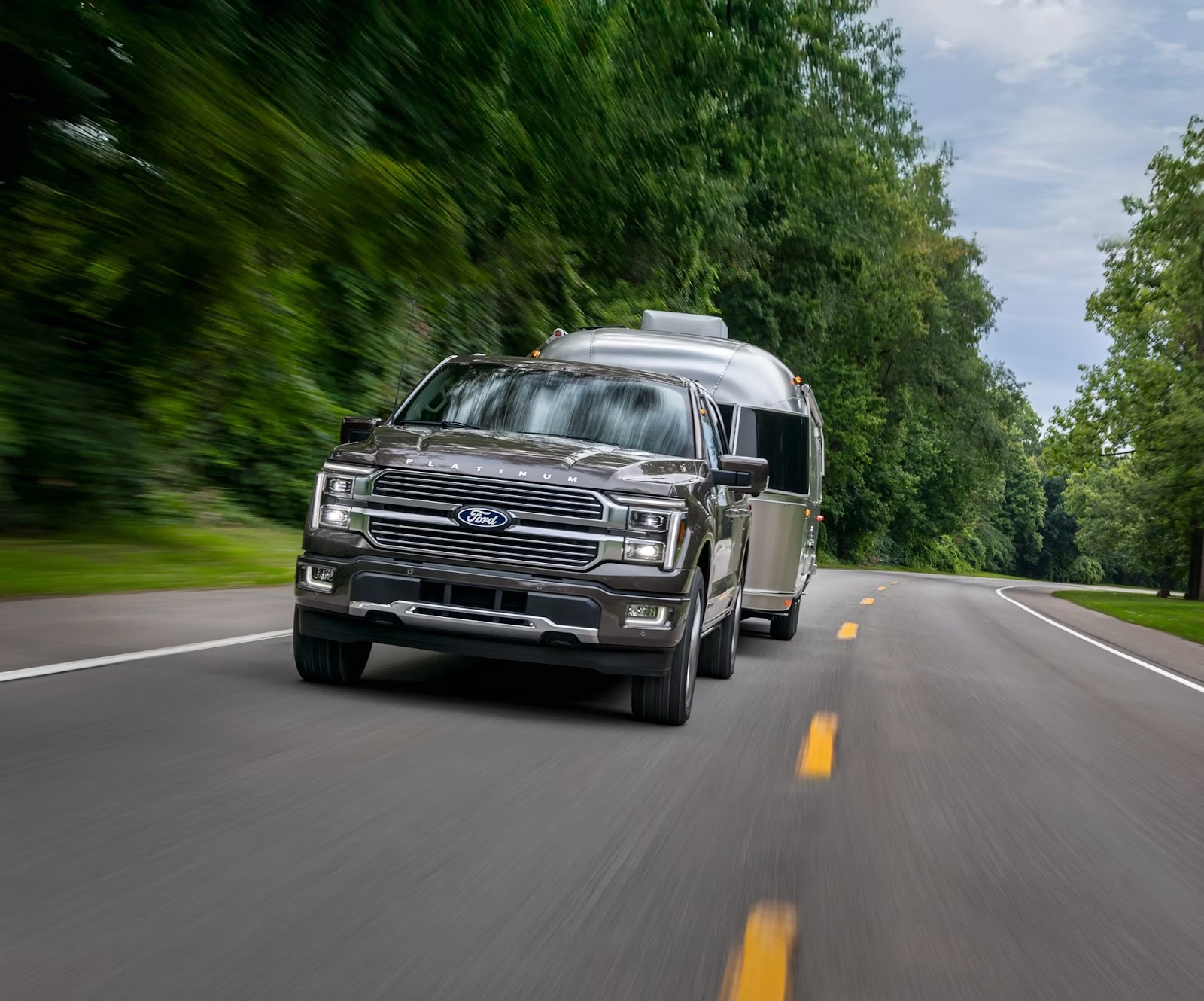
Both the EcoBoost V6 and 5.0L V8 deliver serious towing capability with different performance characteristics
Fuel Efficiency and Operating Costs Comparison
Fuel economy differences between the EcoBoost and V8 are smaller than many buyers expect, especially when towing. The 3.5L EcoBoost achieves an EPA-estimated 20 MPG combined in 4x2 configuration, while the 5.0L V8 delivers approximately 19 MPG combined. Under load, both engines work harder and fuel economy drops proportionally to trailer weight and aerodynamics.
Which Engine Offers Better Fuel Economy When Towing?
When towing heavy loads, the fuel economy gap between the EcoBoost and V8 narrows considerably. Both engines operate at higher RPMs and loads, which reduces the EcoBoost's efficiency advantage. Real-world towing fuel economy typically ranges from 10-14 MPG for both engines depending on trailer weight, aerodynamics, and terrain. The EcoBoost may deliver slightly better economy when towing lighter loads (under 7,000 pounds) where it can stay out of boost more often. The V8's naturally aspirated design means more consistent fuel consumption across different load conditions.
Maintenance and Long-Term Reliability
Both engines have proven track records in F-150 applications. The 5.0L V8 uses a simpler naturally aspirated design with fewer components than the twin-turbo EcoBoost, which some owners prefer for long-term maintenance simplicity. The EcoBoost requires attention to oil change intervals and cooling system maintenance due to its turbocharged design. However, Ford's warranty coverage and the widespread availability of service expertise at dealerships like Serra Ford Rochester Hills in Rochester Hills means both engines receive excellent support throughout their service life.
| Factor | 3.5L EcoBoost V6 | 5.0L Ti-VCT V8 |
|---|---|---|
| EPA Combined MPG (4x2) | ~20 MPG | ~19 MPG |
| Towing Fuel Economy | 10-14 MPG (load dependent) | 10-14 MPG (load dependent) |
| Recommended Fuel | 87 octane regular | 87 octane regular |
| Oil Change Interval | Every 7,500-10,000 miles | Every 7,500-10,000 miles |
Making the Right Engine Choice at Serra Ford Rochester Hills in Rochester Hills
The best engine for towing depends on your specific use case rather than spec sheet maximums. If you regularly tow at or near 10,000+ pounds, the 3.5L EcoBoost's extra torque and higher max capacity provide valuable margin. If you tow in the 7,000-10,000 pound range and value traditional V8 throttle response, the 5.0L delivers excellent capability with predictable power delivery. For occasional light towing under 8,000 pounds, even the base 2.7L EcoBoost handles the job confidently.
What Features Enhance Towing in the 2026 Ford F-150?
Beyond engine choice, the 2026 F-150 includes advanced towing technology that works with both powertrains. Pro Trailer Backup Assist uses a knob on the dashboard to steer the trailer while you control speed with the brake pedal—it eliminates the learning curve of backing trailers. The available 360-degree camera system provides multiple views around the truck and trailer for tight maneuvering. Trailer sway control automatically applies brakes and reduces engine power if it detects trailer oscillation. The integrated trailer brake controller adjusts braking force based on trailer weight and allows manual override when needed.
Best Engine for Towing with the 2026 Ford F-150
For maximum conventional towing capacity, the 3.5L EcoBoost V6 is the clear choice at 13,500 pounds when properly equipped. Its 500 lb-ft of torque provides strong acceleration with heavy loads and confident performance on grades. However, "best" depends on your actual towing needs. The 5.0L V8's 12,800-pound capacity covers most towing scenarios while delivering traditional V8 characteristics that many experienced towers prefer. Visit us at 2890 S Rochester Rd, Rochester Hills, MI 48307 to compare both engines in person and discuss your specific towing requirements.
| Towing Scenario | Recommended Engine | Why |
|---|---|---|
| Heavy trailers 10,000+ lbs | 3.5L EcoBoost V6 | Maximum capacity and torque for frequent heavy towing |
| Medium trailers 7,000-10,000 lbs | Either engine works well | Choose based on driving preference and budget |
| Light trailers under 7,000 lbs | 2.7L EcoBoost V6 or 5.0L V8 | Both provide capability with better fuel economy |
| Frequent mountain/grade towing | 3.5L EcoBoost V6 | Higher torque maintains speed on climbs |
| Traditional V8 preference | 5.0L Ti-VCT V8 | Linear power delivery and proven reliability |
Remember that configuration matters as much as engine choice. The Max Trailer Tow Package, proper axle ratio, and favorable cab/bed/drivetrain combination all affect your truck's actual towing capacity. Our team at Serra Ford Rochester Hills reviews door sticker ratings and helps you build or select a truck that delivers the capability you need without paying for features you won't use. Call 248-844-2090 to schedule a consultation with our towing specialists.
Experience the 2026 F-150's Towing Capability at Serra Ford Rochester Hills
Choosing between the 5.0L V8 and 3.5L EcoBoost for towing is easier when you experience both engines in person. At Serra Ford Rochester Hills, located at 2890 S Rochester Rd, Rochester Hills, MI 48307, we maintain a diverse inventory of 2026 F-150 trucks with different engine and configuration combinations. Our sales team includes experienced towers who understand real-world towing requirements and can help you match engine choice to your specific needs.
We encourage Rochester Hills area drivers to schedule your test drive with attention to throttle response, acceleration feel, and how each engine delivers power. If possible, bring information about your trailer—weight, tongue weight, and typical load—so we can verify that your chosen configuration provides adequate capacity with comfortable margin. Our service department can also discuss maintenance requirements and long-term ownership considerations for both engines.
Beyond the truck itself, Serra Ford Rochester Hills offers genuine Ford accessories designed specifically for towing: upgraded hitches, trailer brake controllers, bed-mounted fifth-wheel systems, and towing mirrors. Our parts and service teams ensure your F-150 remains in optimal condition for safe, confident towing throughout its service life. Contact us at 248-844-2090 or visit our 2026 F-150 overview page to learn more about available inventory and current offers.